

Fan Coil Unit Company Expertise You Need for Smarter Climate Control
2026-10-30
Most fan coil unit suppliers can quote a spec sheet. Few can tell you why a unit whistles at 3 a.m., or how to balance a four-pipe system without guesswork. At shairko, that kind of practical expertise isn't an add-on—it's the whole point. If you're tired of generic climate control advice and ready for solutions that hold up in the real world, you're in the right place.
Rethinking Fan Coil Design from the Inside Out
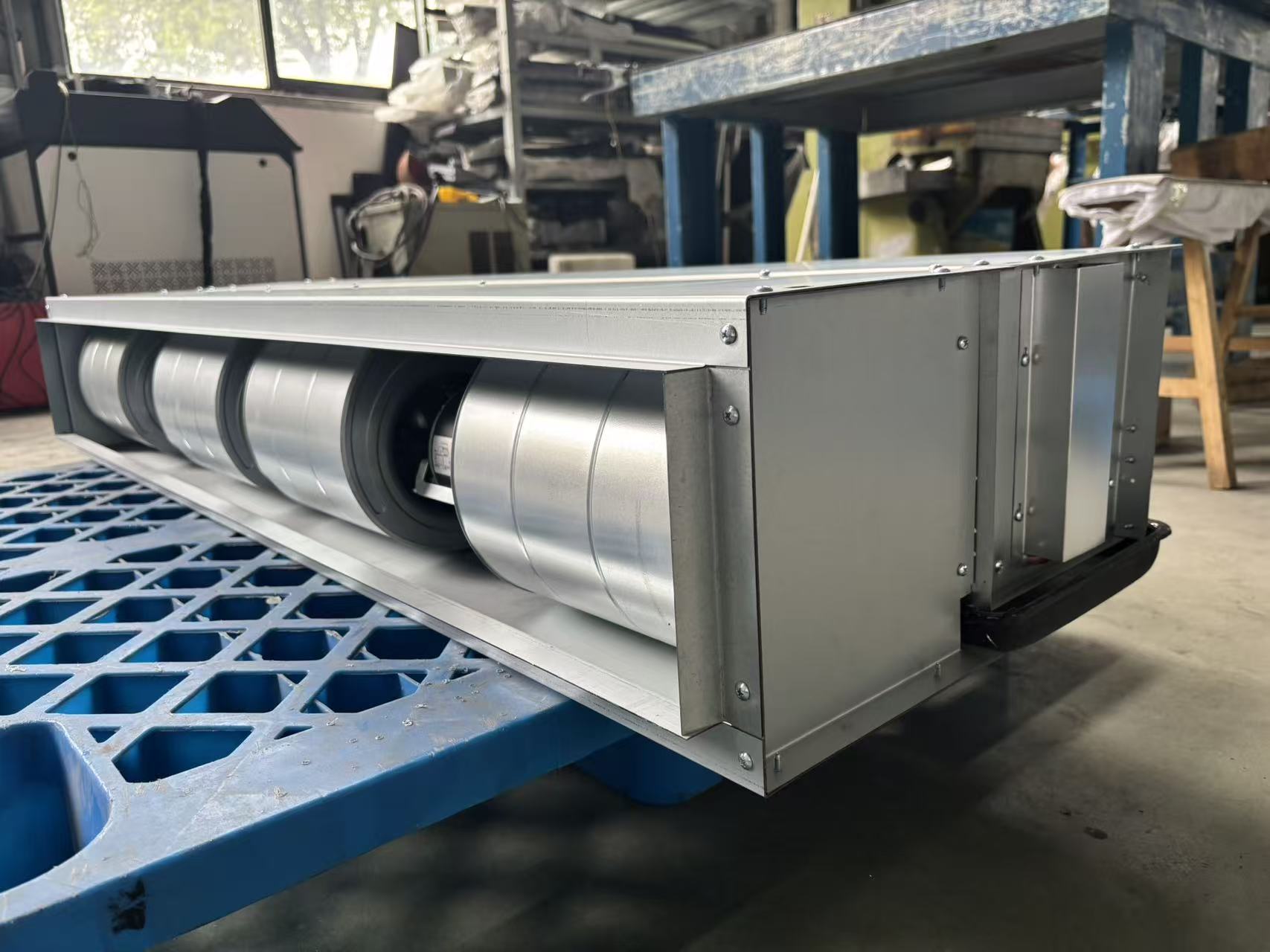
Most fan coil units are still built around a decades-old assumption: that the blower, coil, and drain pan can be treated as separate modules bolted into a metal box. Step back and that logic crumbles. The real performance bottlenecks—air leakage, thermal short-circuiting, condensate carryover, and noise—are not component problems. They are interface problems. Rethinking the design from the inside out means starting with the airflow path and letting every surface earn its place, rather than forcing a standard chassis to accept whatever fits.
In practice, this flips the usual design sequence. Instead of selecting a fan first and then bending sheet metal around it, you map the exact pressure profile across the coil face, then shape the housing to smooth turbulence before it starts. The drain pan stops being a shallow tray and becomes a sloped, insulated contour that directs water away even under low-load humidity swings. Even the motor mount changes: by integrating it with the inlet ring and eliminating unnecessary brackets, you remove vibration paths before they reach the occupied space. None of these moves are exotic. They simply refuse to accept the old compartmentalized layout as a given.
The result is a unit that looks unremarkable from the outside but behaves differently under real operating conditions. Airflow stays steadier as filters load, sound levels drop a few decibels without adding insulation, and maintenance becomes less about fixing leaks and more about routine cleaning. That is the quiet victory of inside-out thinking: it does not chase a single headline spec. It removes the hidden compromises that, over years of service, quietly erode comfort and efficiency.
Where Building Physics Meets Unit Selection
Choosing a unit often starts with floor plans and square footage, but the real test of comfort comes down to building physics. How sound travels through a party wall, how morning light enters a bedroom, or how heat builds up on a west-facing balcony all shape daily life more than a layout diagram ever will.
The same building can feel completely different from one unit to the next once you account for thermal mass, window-to-wall ratios, and prevailing wind directions. A corner unit on the top floor might soak up too much afternoon sun, while a middle unit facing the courtyard could stay naturally cool but lack cross-ventilation. These aren't abstract concerns—they're the physical realities that decide whether you reach for a sweater or a fan every evening.
When building physics meets unit selection, the smart buyer starts treating every choice as a small climate experiment. Ask how the facade handles rain and condensation, whether the glazing reduces low-frequency traffic noise, and where the thermal bridging occurs. The answers will tell you far more about long-term livability than any render or staging ever could.
Noise Reduction That Doesn't Sacrifice Output
Most noise reduction tools work like a heavy blanket—they muffle the unwanted hiss, but they also flatten the transients and air that give a recording its life. The result is cleaner, yes, but also smaller, duller, and strangely distant. The goal here isn't just to remove noise; it's to preserve the exact character of the source, from the bite of a snare to the breath behind a vocal. That means treating noise as a separate layer, not something to be filtered out of the whole signal blindly.
Instead of a static threshold, the process adapts to the material in real time. Quiet passages don't get sucked dry, and loud moments don't trigger pumping artifacts. You can hear the room tone remain consistent, but the hum from a nearby fridge or the hiss from a cheap preamp simply fades into irrelevance—without making the track feel like it was recorded in a vacuum. It's the difference between a blanket and a surgeon's scalpel: the same tissue removed, but everything else left intact.
The practical upshot is that you spend less time chasing artifacts and more time on the actual mix. A guitar track still has its pick attack, a voice still has its sibilance, and a drum bus still has its crack. There's no need to add back artificial brightness or reverb to compensate for what the noise reduction stole. You get the clarity you wanted, with the output level and tone you already had.
Smart Climate Control Without the Learning Curve
Most smart thermostats expect you to learn their habits before they learn yours. This one doesn't. It picks up on how your home actually responds to heating and cooling, then adjusts in the background without asking you to set schedules or tweak preferences every other day. You come home to a comfortable room, not a prompt asking if you'd like to enable eco mode for the third time.
The interface is stripped back to what you actually use: current temperature, a simple dial you can turn if you want to, and a small note showing when the system last adapted on its own. No buried menus, no five-step wizard to set a weekly plan. If you ignore it for a month, it still works better than most systems you'd spend an afternoon configuring.
Because it watches humidity, sunlight, and thermal drift rather than just a clock, it avoids the classic smart-home trap of being overly clever at the wrong moment. You won't wake up sweating because the algorithm thought you'd left for the day. It's smart climate control that assumes you have better things to do than manage it.
Real-World Performance Data Over Lab Promises
Lab numbers look impressive because they're captured in near-perfect conditions: a freshly wiped device, constant room temperature, and no push notifications fighting for CPU cycles. Spend a week with that same phone or laptop and the gap shows up fast. Battery life that was quoted at 18 hours becomes closer to 9 once you mix video calls, GPS, and spotty cellular coverage. A storage drive that posted 7,000 MB/s in a sequential test can feel just average when handling thousands of small files from an old project folder.
Thermal behavior is another place where real-world data calls out lab promises. Most benchmark runs are short enough that the cooling system never gets saturated. In a normal workday, though, sustained exports, compiles, or gaming sessions force the hardware to lower its clock speeds to stay within safe temperatures. That means the peak frame rate or render time you saw in a review may not hold up after thirty minutes. Independent testers who log performance over time often find a 15 to 25 percent drop from the headline figure.
Network throughput claims have the same problem. Advertised Wi-Fi speeds assume you are standing a few feet from a high-end router with no interference. Real homes and offices have thick walls, microwave ovens, and a dozen other devices sharing the airtime. Crowd-sourced speed data regularly shows median real-world throughput running at half or less of the marketing number, which is why field tests and user panels are more useful than spec sheets when deciding what to buy.
Scalable Comfort for Every Zone
Comfort shouldn’t be one-size-fits-all. With a system designed to grow alongside your space, you can start small in a single room and expand to cover every corner as needs change. No rewiring, no rigid layouts—just quiet, responsive control that matches how you actually live or work.
Each zone operates independently, so the sun-drenched office stays cool while the basement keeps its warmth. Adjustments feel immediate, not like a compromise. You’re not paying to condition empty rooms, and you’re not fighting over a single thermostat anymore.
The real advantage is flexibility. Add a zone when the guest room becomes a nursery, or when the garage turns into a workshop. The system adapts without major surgery, keeping everyone comfortable without a complicated setup.
FAQ
Look for a team that asks about room usage, occupancy patterns, and existing ductwork before recommending equipment. The right partner will also share measured sound data and part-load efficiency figures rather than only quoting nominal capacity.
It starts with proper zoning and water flow balancing. Experienced engineers match coil sizing and fan speed settings to the actual thermal load of each space, which reduces hot and cold spots without overworking the system.
Modern units can connect to building management systems or local smart thermostats that adjust fan speed and valve position based on occupancy and humidity. Good companies help you configure these inputs so the system reacts smoothly instead of constantly cycling.
Not only. Noise also comes from grille design, motor type, and how the cabinet isolates vibration. A company with hands-on commissioning experience will check duct connections and static pressure, not just select a low decibel rating from a catalog.
By focusing on part-load performance, maintenance access, and control integration. For example, EC motor options and pressure-independent valves can lower energy use during off-peak hours, and a well-planned layout makes filter changes and coil cleaning faster.
Ask how the unit selection was modeled for your space, whether the coil is sized for the actual chilled water temperature, how noise was tested, and who will handle start-up commissioning. Clear answers show the provider understands the whole system, not just the box.
Commissioning verifies that water flow, fan speed, and control signals match the design intent. Without it, even a high-quality unit can waste energy or fail to reach setpoint because valves may be hunting or sensors may be placed incorrectly.
Yes, if the company evaluates the existing pipe sizes, supply temperatures, and control voltage first. Retrofits often require different coil types or flow configurations, and an experienced provider will adapt the unit selection to those field conditions rather than forcing a standard product.
Conclusion
True expertise in fan coil units starts by rejecting off-the-shelf assumptions. We rebuild these systems from the inside out, questioning every component—from coil geometry to motor placement—so that each unit works harder without working louder. Unit selection isn't a guessing game; it's a deliberate match between the building's thermal envelope, occupancy patterns, and ventilation loads. By grounding every recommendation in building physics rather than generic capacity charts, we avoid the common trap of oversized, inefficient coils. And when it comes to acoustics, we treat noise not as an afterthought but as a design constraint. Our approach trims low-frequency rumble and high-pitched hiss through better airflow paths, insulated casings, and tuned fan speeds—delivering the same cooling or heating output at sound levels that fade into the background of a quiet office or bedroom.
What sets our work apart is that we bring smart climate control without forcing building operators through a steep learning curve. The controls are simple enough for a facility manager to adjust on day one, yet robust enough to handle variable occupancy and shifting solar loads automatically. We don't lean on laboratory promises; every performance claim we make is backed by field data from occupied buildings—measured airflow, actual delta-T, and logged energy use across seasons. That data drives continuous fine-tuning, not one-time commissioning. Finally, scalability is built in: the same platform and design logic adapt from a single conference room to a 40-story tower, keeping each zone comfortable without overcooling or wasteful reheat. This is how smarter climate control becomes an everyday reality, not a spec-sheet fantasy.
Contact Us
Contact Person: Crystal
Email: [email protected]
Tel/WhatsApp: 8613524235353
Website: https://www.airkohvac.com