

Boron Carbide Tiles Vendor Guide: What to Consider Before Buying
2026-10-21
Choosing the right boron carbide tiles can make or break your ballistic protection project—yet too many buyers focus only on price and later face costly failures. From raw material purity to sintering consistency, the devil is in the details that most vendor guides gloss over. Whether you're sourcing for body armor, vehicle plating, or industrial wear applications, knowing what to ask before you sign the purchase order is critical. At HUAYI TECH, we've seen how the wrong tile choice leads to delamination, uneven density, and premature cracking. This guide cuts through the marketing noise and walks you through the exact factors that separate a dependable boron carbide supplier from a risky one—so you can buy with confidence, not guesswork.
Start With the Powder, Not the Polished Surface
Powder is where the real story begins. A polished surface looks finished, but it hides everything that went wrong underneath — the uneven grain, the rushed mixing, the shortcuts you'd rather not name. Working with raw powder forces you to confront those details before they become permanent. You get to feel the texture, adjust the moisture, and build strength from the ground up.
Polished surfaces seduce with their shine, but shine is just reflection. It bounces attention away from substance. When you start with powder, you're dealing with substance itself: particles that haven't yet agreed on a shape. That's where you can introduce your own variables — a different mineral ratio, a slower bind, an unexpected additive that later becomes your signature. No premade finish offers that kind of freedom.
Most people skip straight to the polished result because it feels safer. But safety rarely produces anything worth remembering. Powder is messy, unpredictable, and honest. It spills, clumps, and refuses to behave. That's precisely why it matters. The next time you're tempted to start with a glossy template, ask yourself what the powder version would look like — and begin there instead.
Why Some Vendors Skip the Hardness Test You Actually Need
A lot of suppliers lean on quick Rockwell or Brinell checks because the machines are cheap to run and the numbers come out fast. The problem shows up when your drawing calls for a microhardness traverse across a case or a specific Knoop reading near a stress riser. That kind of testing takes time, sample prep, and a technician who actually knows how to section a part without burning the edge. If the vendor doesn't own the right indenter or hasn't trained anyone to do the mount-and-polish work, they'll quietly substitute a surface reading and hope nobody notices the difference.
There's also a deeper reason: avoiding the test means avoiding the conversation. A proper hardness profile can expose shallow case depth, decarburization, or uneven quench response that a single convenience reading will never catch. For critical parts, that missing data isn't neutral—it shifts risk onto your assembly. The suppliers worth keeping are the ones who ask where you need the indent made, what load matches the spec, and whether they should cut a cross-section rather than test a random flat. If they keep dodging that question, the hardness number they hand you is probably more about their process limits than your part's actual condition.
The Difference Between Hot Pressed and Pressureless Sintered Tiles
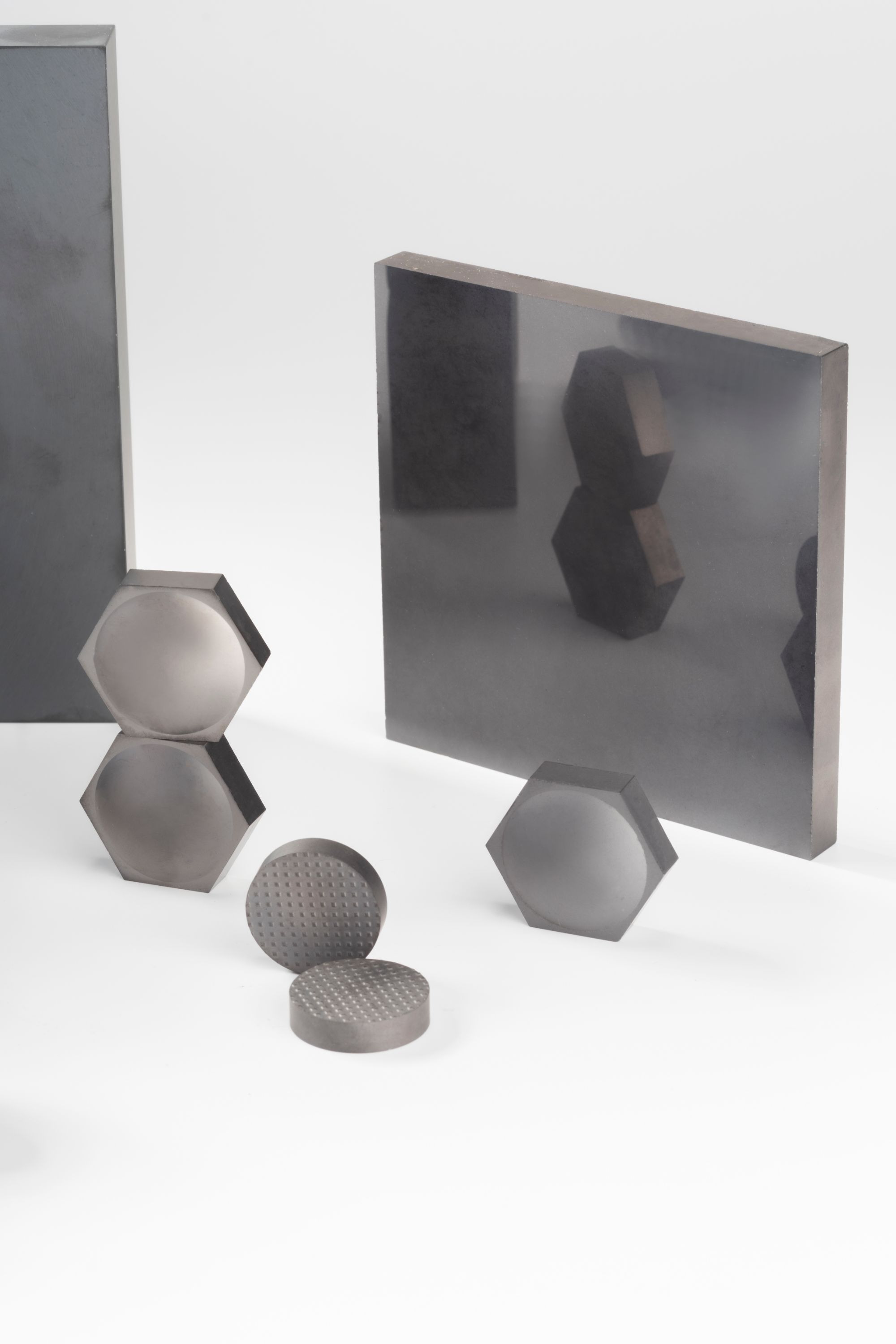
Hot pressed tiles are formed by applying both high temperature and mechanical pressure simultaneously inside a graphite mold. This process forces the ceramic powder to densify rapidly, yielding a tile with extremely low porosity, a fine uniform grain structure, and exceptional hardness. Because the pressure is uniaxial, the tile often exhibits slightly directional properties, and the surface can be polished to a near-mirror finish without additional glazing. However, the mold size limits the tile dimensions, and the production speed is relatively slow, which pushes up cost.
Pressureless sintered tiles, by contrast, are first compacted into a green body using a conventional press, then heated in a kiln without any external mechanical pressure. Densification relies purely on atomic diffusion and particle rearrangement driven by heat alone. The resulting tile tends to have a slightly higher porosity and a coarser grain structure compared to hot pressed ones, but it can be manufactured in larger formats and far more economically. The lack of directional stress also makes pressureless sintered tiles more predictable in terms of thermal expansion and mechanical behavior across different axes.
In practical terms, the choice comes down to application requirements. For high-end decorative surfaces where flawless gloss and scratch resistance are paramount—such as luxury bathroom walls or feature panels—hot pressed tiles justify their higher price. For large-scale flooring or exterior cladding where cost per square meter and dimensional flexibility matter more than ultimate density, pressureless sintered tiles remain the workhorse. Neither is universally better; they simply serve different priorities in modern architecture.
How to Spot a Vendor That Knows Your Lining Application
A vendor that truly knows linings won't start with a product pitch. They'll ask about your substrate preparation, the chemical exposure range, and whether you're dealing with thermal cycling or abrasive flow. If their first questions revolve around your actual operating conditions rather than their catalog, that's a strong signal.
Listen for how they talk about failure. A knowledgeable supplier can explain why linings blister, crack, or delaminate in specific environments, and they'll suggest preventive measures that match your application. Vague promises of "chemical resistance" without details usually mean they're reading from a datasheet, not experience.
Finally, watch their approach to validation. The right vendor will propose a patch test or a small-scale trial before you commit to a full lining project. They understand that lab data doesn't always translate to your exact field conditions, and they're willing to prove their solution works on your surface, with your chemicals, under your schedule.
What a Properly Packed Crate Tells You About the Supplier
A properly packed crate reveals far more than basic shipping competence. Look closely at the wood selection, joint reinforcement, and how the internal bracing is arranged—these details show whether the supplier has handled similar cargo before. Suppliers who invest in solid crate construction rarely compromise on product quality or lead times.
What sits inside the crate matters just as much as the outer frame. Moisture barriers, desiccant packs, and custom-cut foam inserts indicate that someone mapped the entire journey from factory floor to final destination. If you find loose hardware, random padding, or gaps around the edges, the supplier's overall attention to quality control is likely just as sloppy.
Consistency across multiple crates is the real tell. When every crate from the same supplier shows the same nail pattern, edge protection, and stencil placement, it points to documented packing procedures and trained staff. That kind of repeatability never happens by accident, and it usually signals a supplier who understands that packaging is a direct extension of the product itself.
Ask for a Trial Tile Before You Commit to a Bulk Order
There's a world of difference between seeing a tile on a screen and holding it in your hand. Colors shift with lighting, textures reveal themselves only when touched, and the subtle variations that make a tile feel artisanal can't be captured in a photo. That's why smart buyers insist on a physical sample before placing a large order. It's not about distrusting the supplier; it's about respecting your own project's outcome.
A trial tile gives you the chance to test how it pairs with your existing materials, how it reacts to your space's natural light, and whether the finish holds up to everyday use. You can scratch it, spill something on it, or simply live with it for a few days. If it still feels right, then you can confidently move forward with the bulk purchase, knowing you've eliminated the guesswork.
Many reputable vendors will send a sample for a small fee or even free, so don't hesitate to ask. Compare a few contenders side by side before making the final call. The few days you spend evaluating samples can save you from costly returns, installation delays, or the quiet disappointment of a room that just doesn't feel the way you imagined.
FAQ
Boron carbide tires aren't your everyday road tires. They combine a ceramic-based compound with a resilient core, giving them extreme hardness and wear resistance. You'd typically see them in specialized industrial or military applications where sharp debris or abrasive surfaces would shred normal tires quickly.
Ask for mill certificates or third-party lab reports that show the boron carbide percentage and trace impurities. A reputable supplier won't hesitate to share this data, and you should look for consistency across production batches rather than a single impressive sample.
Depending on your region, look for adherence to ISO or ASTM standards relevant to ceramic materials and tire safety. A vendor that can provide documentation for hardness, density, and impact resistance is usually more reliable than one offering vague assurances.
Yes, many vendors offer custom sizing and tread patterns. However, custom orders often come with longer lead times and higher minimum order quantities. Make sure the vendor has proven experience with your vehicle type, whether it's a mining truck or a specialized rover.
Be wary of vendors who can't provide clear pricing breakdowns, lack a physical address or verifiable past clients, or push for full payment before any sample approval. Also, unusually low prices often mean lower boron carbide content or poor bonding between layers.
It's crucial, especially if you're using these tires in harsh environments. Ask about technical support, replacement policies, and whether the vendor offers on-site installation guidance. A vendor that disappears after the sale can leave you stranded with costly equipment downtime.
Absolutely. A small test batch lets you evaluate the tire's wear rate, grip on your specific surfaces, and overall build quality. Don't skip this step even if the vendor has glowing testimonials—your operating conditions may differ from their previous customers'.
Standard sizes might ship in 4–6 weeks, but custom orders can take 3–6 months depending on production backlog and material sourcing. Always confirm lead times in writing and build buffer into your procurement schedule.
Conclusion
A vendor's polished sample tells you almost nothing about how the tile will hold up. You need to ask about the raw boron carbide powder first—its purity, particle size distribution, and whether it came from a consistent source. A lot of shops can make a smooth surface, but if the underlying powder has irregular grain sizes or excess free carbon, the tile will underperform in abrasive service. Next, don't accept a generic hardness certificate. Many vendors quote Vickers hardness from a polished face, which can be misleading because it reflects surface preparation, not the bulk material. Ask specifically for a Knoop or Vickers indentation on a fractured cross-section, and check the load used. Some vendors quietly skip this test because their low-cost powder blend won't meet the minimum you actually need for a lining that sees sliding wear.
The processing route matters just as much as the powder. Hot pressed tiles typically show higher density and better wear resistance than pressureless sintered ones, but they cost more and have size limits. Not every application needs hot pressed material; a knowledgeable vendor will ask about your lining's temperature, impact, and media type before recommending either. Watch for that conversation—if a supplier quotes a price without understanding your wear mechanism, walk away. The same instinct applies to packaging. A supplier that wraps tiles individually, uses rigid dividers, and bolts the crate frame will likely care about edge integrity during transit. Finally, never commit to a full batch without testing two or three blind-coded trial tiles from the actual production line, not handpicked samples. Run them side by side against your current lining and let the wear data, not the sales pitch, drive the decision.
Contact Us
Contact Person: Junting Leo
Email: [email protected]
Tel/WhatsApp: +86 18615009766
Website: https://www.huayimaterial-china.com/