

China Chevron Belt Supplier You Can Rely On for Durable Conveyor Solutions
2026-11-27
If you’ve ever replaced a chevron belt months too early or watched material slip on a steep incline, you already know “durable” gets thrown around far too easily in conveyor sourcing. XAN takes a different approach as a China chevron belt supplier, focusing on rubber compound, fabric tension, and edge sealing long before a belt reaches your line. In this guide, we’ll look at what actually makes a chevron belt hold up under real operating conditions—and how to spot the difference before downtime eats into your output.
What Actually Matters When Choosing a Chevron Belt Supplier in China
Most buyers start by comparing price sheets, but the real test happens long before a container leaves the port. Ask the supplier how they control compound hardness and belt gauge across different production batches. A chevron belt that looks identical in photos can behave very differently under load if the rubber blend changes quietly between orders. Request a small batch first, cut a section, and check the profile height, base thickness, and fiber ply bonding rather than relying on a generic datasheet.
Another factor that gets overlooked is how the factory handles curing pressure and splice readiness. Chinese suppliers with newer rotocure lines tend to hold chevron profiles more evenly, especially on wider belts. It is worth asking for their internal rejection rate or a recent production record instead of asking for a broad "quality guarantee." Shipping also matters more than many buyers expect: chevron belts are bulky and can shift in the container if rolled loosely, so confirm the rolling direction, steel pallet use, and moisture protection before confirming the order.
Finally, pay attention to communication clarity after the order is placed. A supplier that can show you a weekly cutting and packing update, and flag any material shortage before it becomes a delay, will save more money than one offering a slightly lower unit price. In this category, consistency and predictable handling usually outweigh a few cents of savings per meter.
Cleat Profiles That Hold the Load Without Overworking the Motor
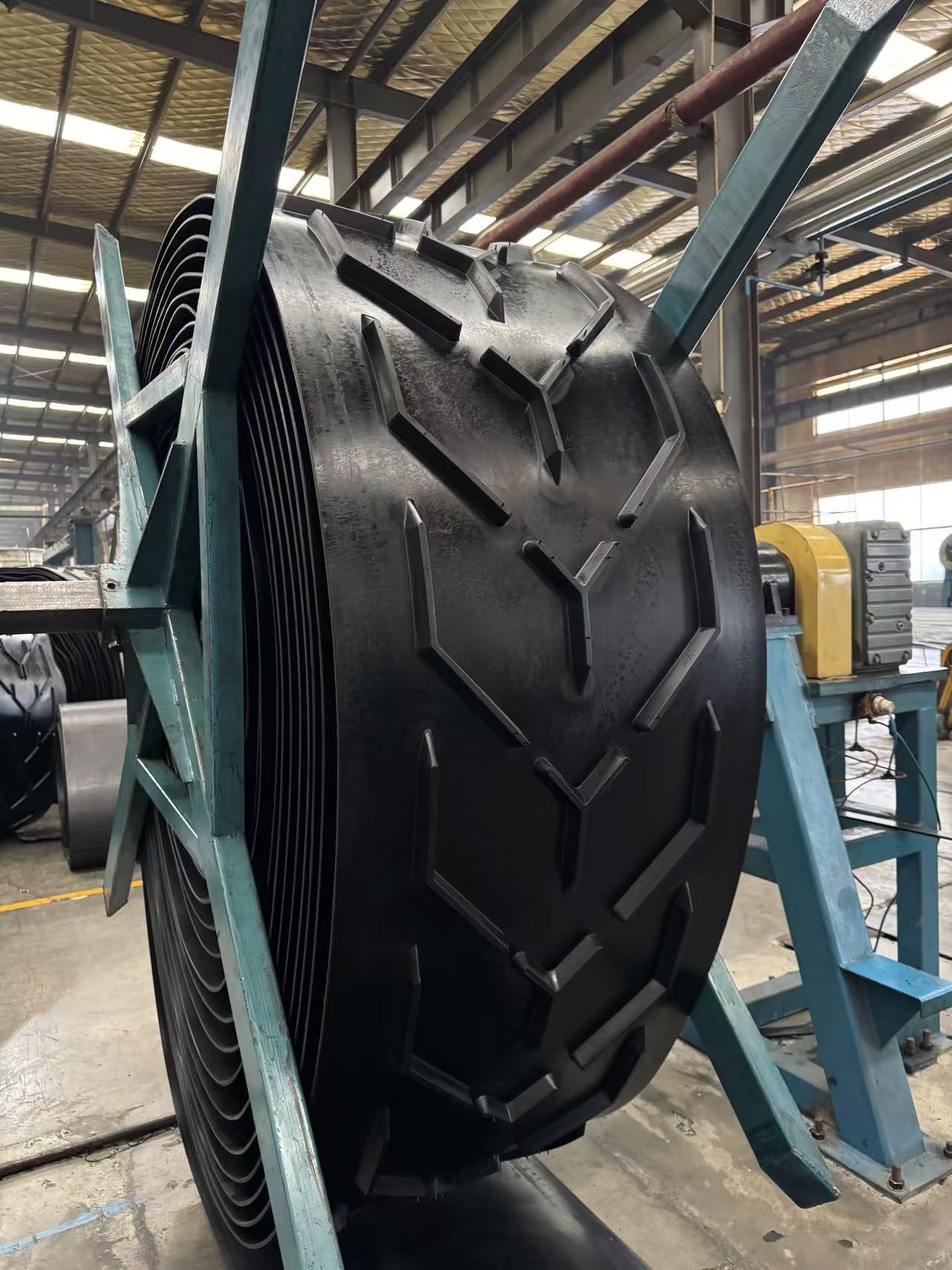
A cleat that grips too hard can be just as costly as one that lets material slide. The useful profiles tend to use a moderate height with a slight forward rake, so the cleat catches the load on steep sections but sheds bulk material cleanly at the discharge point. That release matters: if the profile traps fines in its base, the belt carries extra dead weight on every return run, quietly raising the torque the motor has to produce.
Spacing plays a larger role than raw cleat height. Wider gaps reduce the total number of cleats in contact with the carcass and give the motor less rolling resistance to overcome, while still providing enough pockets for stable transport. Tapered sidewalls or shallow chevron cuts can add lateral grip without increasing the full-width surface area that drags against skirting or idlers.
The best designs pair a firmer leading edge with a softer, more flexible trailing edge. The leading edge resists load shift during acceleration, while the trailing edge flexes as it rounds the head pulley. That flex lowers the peak bending force and keeps amp draw from spiking every time a cleat passes through the pulley zone.
Reading Rubber Compounds for Abrasion and Heat Before You Buy
Rubber compounds are rarely one-size-fits-all, and the balance between abrasion resistance and heat tolerance often decides whether a part survives real working conditions. Start by checking the filler system: carbon black and silica both reinforce rubber, but they distribute stress differently. High-structure carbon black tends to improve cut and chip resistance, while finer particle grades can push heat buildup higher. If a supplier only lists hardness and tensile strength, ask for abrasion index or DIN loss values. Those numbers give a much clearer picture of how the surface will hold up when dragged, scraped, or hit by repeated debris.
Heat tells a separate story. A compound that resists wear at room temperature may soften or degrade quickly once temperatures climb past its continuous-use limit. Look at the polymer backbone first. Natural rubber offers excellent tear strength but weakens under sustained heat, while EPDM or HNBR can handle higher thermal loads with better retention of physical properties. Also pay attention to the cure system and antioxidant package, since these influence how the material ages over time. A part that spends hours near an engine or press needs more than a high flash point; it needs stable modulus and low compression set at operating temperature.
Finally, test under conditions that mimic your actual use. Abrasion resistance measured with a rotating drum tells you little about impact wear from sharp edges, and oven aging alone will not reveal how heat and friction combine to break down the surface. Request samples and run them through your own worst-case scenario, even if the test is rough. The right compound usually involves a compromise: you may trade a few points of abrasion resistance for better hot tear strength, or accept slightly higher hardness to prevent heat softening. Knowing which trade-off matters more in your application is what separates a generic purchase from a durable one.
Why Incline Angles Change the Way You Should Specify Belt Tension
A belt running on a steep incline carries part of its load uphill, which directly alters how tension distributes along the carrying and return sides. Most standard tension assumptions lean toward a mostly horizontal path where the drive mainly overcomes friction, acceleration, and small changes in elevation. On an incline, the motor must also lift the belt and material against gravity, so the high-tension zone near the drive grows faster than a flat layout would suggest. Specifying tension without accounting for that slope can leave the return side too slack or place excessive stress on splices near the head pulley.
Inclined sections also change where sag becomes a problem. The belt may appear tight at the drive but still droop between idlers partway up the carry side because the gravity component acting along the slope reduces the effective tension available to keep the belt profile flat. As the angle increases, the counterweight or take-up position that works for a level system often fails to hold the correct sag on the incline. This is why the angle should be treated as a direct input in the tension calculation rather than as a minor correction applied after choosing a standard belt rating.
Additionally, the return side on an incline does not shed tension the same way it does on flat ground. The empty belt still has to be pulled up the slope, so the tail tension needs to be high enough to prevent slip across the drive pulley, but not so high that the belt becomes over-tensioned at the top. A useful rule is to calculate the tension at the tail first, then add the full lift component to estimate the head-side tension instead of simply using a fixed sag ratio. That approach keeps the specified tension closer to what the belt actually sees during start-up and steady running on the incline.
Questions to Ask About Batch Consistency and Raw Material Sourcing
Batch definitions vary more than most people expect. One supplier might treat a single harvest as a batch, while another groups multiple lots into a production run, and that changes what your test results actually represent. Before placing an order, ask whether each finished batch has its own certificate of analysis with full quantitative data—not just a pass/fail mark—and request the raw material’s country of origin, cultivar or species, and the point at which it was tested.
Dig into the limits and methods too. A spec sheet that only lists heavy metals and microbial counts leaves too much room for variation in the compounds you care about. Ask which marker compounds are quantified, what acceptance range is used, and whether the lab method is compendial or developed in-house. It also helps to know what happens when a batch misses a limit: is it quarantined, reworked, or quietly blended down?
Upstream is where most inconsistencies start. A supplier with strong batch consistency should be able to show audit records for growers or processors, chain-of-custody documentation, and retained samples kept beyond the product’s shelf life. If the material is botanical or seasonal, ask how they manage crop-year changes—whether by adjusting specifications, blending carefully, or rejecting lots that drift too far.
Delivery Timelines and Packaging Details That Prevent Costly Downtime
A delivery date on a purchase order rarely tells the full story. The schedules that actually keep a line running include transit checkpoints, dock receiving windows, and a named contact who knows whether the freight elevator will be free at 6 a.m. Without those details, a shipment can sit in a warehouse over a weekend while a machine stays dark. Suppliers that share carrier names, tracking numbers, and realistic buffer times make it easier to reschedule maintenance around a late truck instead of discovering the delay after the crew has already arrived.
Packaging matters just as much once the crate is opened. Moisture-sealed bags, anti-static wrapping for controls, and foam cut to the exact shape of a casting prevent the kind of hidden damage that turns a two-hour swap into a two-day diagnosis. Labels should list not just the part number but also the orientation, weight, and lift points. A well-packed box may look unremarkable, yet it is often the difference between a part that powers up on the first attempt and one that triggers a chain of fault codes.
The real benefit appears when these two areas are treated as one workflow. A packaging mistake caught at the dock can be corrected before the old component is removed, and a clear delivery window lets the team stage tools and lockout procedures ahead of time. That coordination reduces the number of hours a critical asset sits idle. In many plants, the most expensive downtime is not the repair itself; it is the waiting created by vague promises and a carton that was never built for the journey.
FAQ
The carcass is built with multi-ply polyester or nylon fabric, and the chevron cleats are molded from a tougher rubber compound rather than glued on. That combination absorbs impact and keeps the profile from peeling even when sharp aggregates drop onto the belt.
Yes. We cut and mold to the exact width, length, and cleat height you need. If you have an old sample or a simple sketch, we can match it without forcing you to redesign the conveyor frame.
Most of our orders come from quarries, cement plants, grain handling, ports, and recycling yards. They usually run on inclined conveyors where smooth belts slip or where material needs extra grip on slopes.
Each batch is checked for thickness, tensile strength, and adhesion between plies. We also keep a small cut sample from every production run so any future order can be matched against the original spec.
For standard widths it is usually 15 to 25 days after the drawing is confirmed. Wider belts or special rubber compounds can add another week, and we are upfront about that before you place the order.
We send splicing and storage instructions with the shipment, and our technical team can walk your crew through installation by call or video if needed. Common wear issues are usually diagnosed the same day.
The chevron profile helps channel water and fine material away from the contact surface, so the belt keeps traction on wet inclines. For oil exposure we can switch to an oil-resistant rubber compound instead of the standard grade.
Conclusion
A conveyor line in a coal yard or quarry rarely fails at a convenient hour, which is why the choice of a chevron belt supplier in China has less to do with polished quotes and more to do with whether the factory can explain how a specific cleat pattern will behave under your incline, load, and moisture conditions. The right partner will ask about lump size and belt speed before recommending a profile, because an aggressive high-V cleat can carry steep material but also adds drag that a smaller drive motor will feel as heat and trip events. The rubber compound matters just as much as the pattern: an SBR-heavy cover may look similar to an abrasion-resistant NR/BR blend but will crack earlier once fines, sharp edges, and ambient heat do their work. At a 15-degree slope you can often run lower tension without sacrificing tracking, yet at 30 degrees or above the belt carcass, take-up length, and drive pulley wrap need to be specified together, not picked from a generic chart.
Consistency is where many supposedly reliable supply chains fall apart. A supplier that changes natural rubber sources or carbon black grades between batches may still meet a basic tensile number while delivering covers that wear unevenly or bond differently to the plies. Before placing a repeat order, it is reasonable to ask for batch-specific mixing records, raw material lot traceability, and test results for abrasion, tensile strength, and elongation rather than a one-time certificate. Delivery and packaging deserve the same scrutiny. Wrapped rolls with edge guards, moisture-resistant film, and crating sized for forklift handling prevent a belt from arriving with creased covers, corroded steel cord, or damaged cleats after weeks at sea. In practice, the dependable Chinese supplier is the one that treats packaging and lead time as part of the product, not as an afterthought, because every day of downtime at the receiving dock costs more than the freight savings ever will.
Contact Us
Contact Person: Anna Lu
Email: [email protected]
Tel/WhatsApp: 8618561668850
Website: https://www.x-conveyor.com