

Industrial 3 Way Ball Valve Applications and Key Benefits Explained
2026-11-21
Most valve guides stop at on/off. An industrial 3 way ball valve does something more interesting: it redirects flow, mixes media, or diverts a single stream into two paths without shutting down the line. That simple difference changes how engineers design transfer systems, bypass loops, and sampling stations. Across chemical processing, water treatment, and oil and gas, the right three-way configuration can cut piping complexity, reduce leak points, and make maintenance far less painful. But not every 3 way ball valve is built for the same pressure, temperature, or switching duty. In this post, we break down the real-world applications and the key benefits that separate a dependable valve from a liability. And if you’re already dealing with tight spaces or aggressive media, UPTAI has solutions worth checking before you finalize your spec.
Where Multi-Port Flow Control Replaces Extra Valves
Multi-port flow control earns its place when the priority shifts from adding components to cutting weight, assembly time, and potential leak paths. On compact mobile equipment, robotic end effectors, and agricultural attachments, a single multi-port block often replaces what used to be a cluster of individual valve bodies joined by elbow fittings, tees, and short hose runs. Fewer external connections mean fewer places for fluid to escape, and the whole circuit becomes easier to package in a tight envelope.
The shift is especially visible in circuits that need to split one inlet stream into several controlled branches. Instead of installing a separate needle valve, check valve, and shut-off for each line, designers route the flow through internal galleries in one machined or manifold-mounted assembly. Lubrication distribution points, multiple clamping stations, and parallel cooling loops all benefit when a shared inlet feeds preset or adjustable port restrictions, because the balance between branches stays more predictable than it would across a chain of loosely connected fittings.
Maintenance also changes for the better, since troubleshooting focuses on one main component rather than tracing a web of interacting valves. Spare parts inventories shrink, and replacement becomes a matter of swapping or servicing a known block instead of rebuilding several separate bodies. The trade-off is that internal passage design has to be handled with care: poor routing can introduce unwanted pressure drop or let one port disturb another, so the compact package still demands a clear understanding of the flow paths inside.
L-Port and T-Port Designs in Everyday Processing Lines
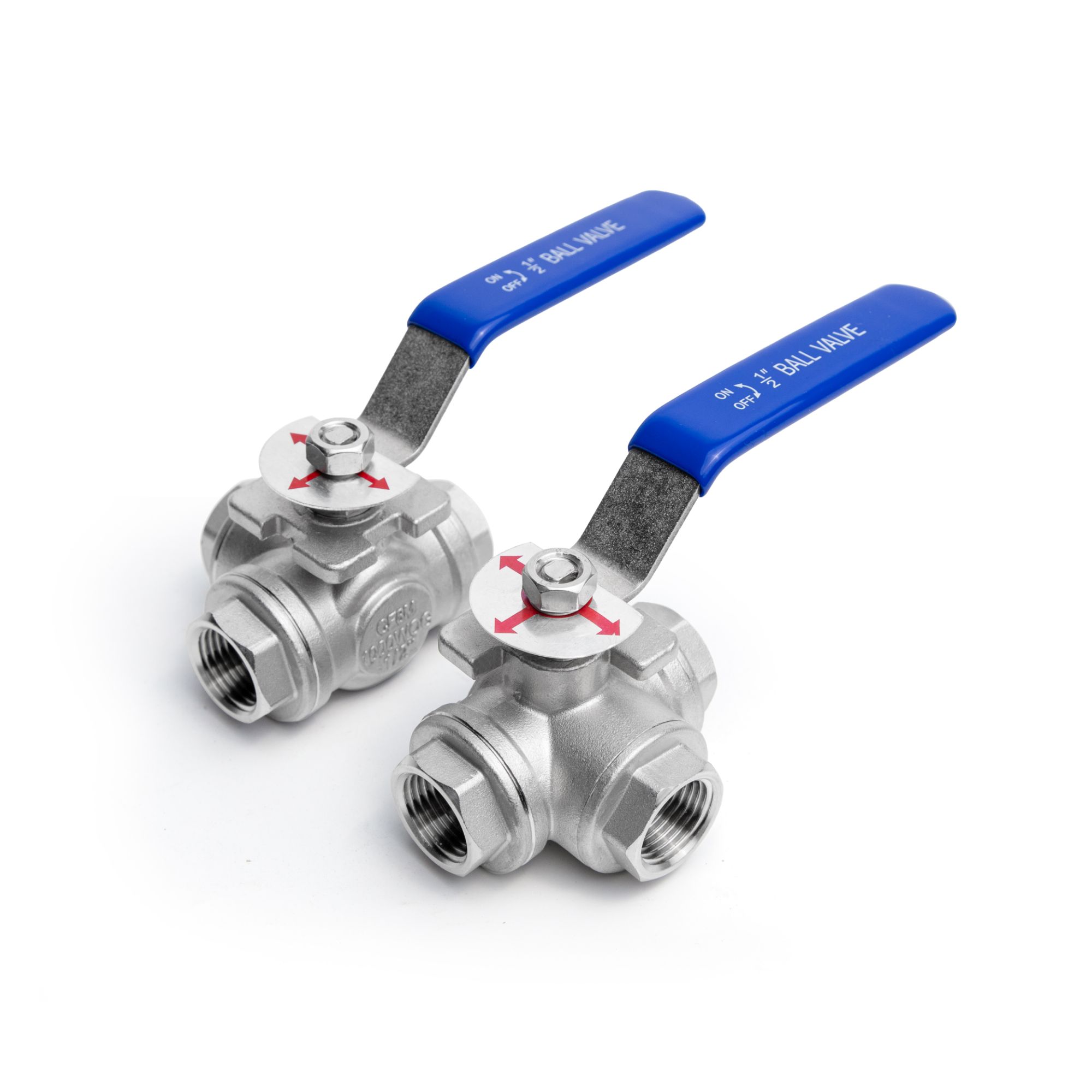
Walk through any beverage bottling hall or dairy plant and you will spot rows of stainless steel valves without giving them a second thought. The real workhorses behind product routing are often the three-way variants, and the difference between an L-port and a T-port comes down to how the internal ball or plug is bored. An L-port connects two adjacent openings at a time, which makes it ideal for simple diverting tasks where a single inlet shifts between two outlets. A T-port, by contrast, can link three openings simultaneously or any pair among them, depending on rotation. That extra flexibility shows up in places like tank recirculation loops, where a single valve might need to blend, bypass, or isolate streams without stopping the line.
Maintenance teams tend to develop strong opinions about which design belongs where. The L-port shines when the process demands a clear either/or choice: sending clean-in-place solution to one tank while another is drained, for instance. Because it cannot accidentally connect all three ports, it adds a layer of foolproofing in manual operations. The T-port, on the other hand, earns its keep in lines that require intermittent mixing or simultaneous flow through a common port. A common setup uses a T-port on a filter housing to switch between normal filtration, backwash, and bypass modes using one actuator instead of three separate valves. That consolidation reduces leak points and simplifies the control sequence, though it also means the operator must pay closer attention to handle orientation during manual overrides.
Selecting between the two is rarely about one being better overall; it is about matching the port configuration to the actual flow logic. A plant that handles viscous products or fluids with particulates may lean toward L-port valves for fewer cavity traps, while a utility loop that needs occasional three-way mixing will favor the T-port. In many older facilities, you will see both types installed side by side, each chosen for a specific junction. Newer installations sometimes standardize on T-port valves with blanked or capped ports to reduce spare parts inventory, but that approach can confuse line operators who assume every valve on the skid behaves the same way. Clear labeling and distinct handle stops become essential when the internal geometry is not visually obvious from the outside.
Common Plant Applications from Chemical Batching to HVAC
In many plants, the same control architecture that meters out emulsifiers and catalysts at a chemical skid also regulates chilled water loops and air handler discharge temperatures. The real difference often comes down to how the setpoints shift during a production run: a batching sequence may hold a vessel at ±1 °F for thirty minutes, while a rooftop unit on the loading dock drifts with outside air and occupancy.
Chemical batching tends to punish sloppy valve timing and poor flow measurement. A few seconds of lag on a dosing line can throw off an entire recipe, so plants lean on tighter PID loops, pulse-width control for small additive streams, and redundant level sensors that cross-check each other before the next stage starts. HVAC systems rarely need that level of precision, but they make up for it with long runtimes and constant disturbances from doors, seasonal swings, and shifting exhaust loads.
Where the two overlap is in utility systems that serve both process and comfort. A shared chilled water header might cool a reactor jacket in the morning and a cleanroom air handler by afternoon. Treating those loops as separate islands usually causes one side to steal flow from the other, so many sites now use demand-based reset strategies rather than holding a fixed differential pressure. That keeps the batching floor stable without forcing the HVAC side into constant valve hunting.
Reducing Leak Points with a Single Compact Body
Every threaded joint, compression fitting, and weld seam is a separate leak point waiting for temperature cycling or vibration to loosen its grip. A single compact body eliminates most of those risks by consolidating the flow path, ports, and mounting surfaces into one piece of machined material. Instead of stacking adapters and unions, the assembly relies on far fewer sealing interfaces.
The practical benefits appear quickly on-site. Installers spend less time aligning multiple connections and checking torque on fittings that can relax over time. Because the body is machined as one unit, seal placement and bore alignment are built into the part rather than created during assembly. That makes leak behavior more predictable and reduces the chance that a slightly under-tightened joint goes unnoticed until startup.
There is also a footprint advantage. Without a chain of adapters branching off a central manifold, the whole assembly stays more compact and easier to fit into tight equipment bays. Fewer external joints also mean fewer spare seals and fittings to stock, which quietly lowers the long-term cost of keeping the system sealed.
Material Pairings for Corrosive and Sanitary Service
Choosing the right material combination is rarely about picking the single most resistant alloy on the shelf. It’s about understanding how two surfaces behave when they rub, seal, or sit against each other in an aggressive environment. A stainless steel valve body paired with a softer PTFE seat, for instance, handles many acids well, but the same pairing can fail quickly when abrasive particles get trapped at the sealing interface. Corrosion resistance means little if the mechanical pairing invites crevice attack or fretting.
In sanitary service the demands shift slightly. The pairing must not only survive chemical exposure and cleaning cycles, but also avoid micro-pits where bacteria can hide. Electropolished 316L paired with carefully selected elastomers like EPDM or FKM works for many food and pharmaceutical lines, yet repeated steam sterilization can harden those seals and change their compression set. A more resilient choice sometimes involves pairing a duplex stainless body with a PEEK seat, accepting a higher initial cost to reduce replacement frequency and contamination risk over years of thermal cycling.
What often gets overlooked is galvanic compatibility between dissimilar metals in the same assembly. A titanium diaphragm next to a stainless steel housing may look fine on paper but can develop localized corrosion at the contact line if the process fluid is conductive enough. The most reliable pairings come from testing candidate couples under real operating conditions, not just checking individual material datasheets. Small changes in temperature, pH, or flow velocity can shift a pairing from long-lasting to problematic in a matter of weeks.
Simple Maintenance Routines That Prevent Early Wear
Most premature wear starts with skipped basics that are easy to miss until they become expensive. Checking oil, coolant, and transmission fluid on a set day each month catches small leaks and contamination before heat and friction do real damage. Keep a log on your phone or a note in the glovebox so changes in level or color stand out instead of fading into guesswork.
Tire pressure, alignment, and rotation sound boring, but uneven tread and low pressure quietly force suspension and steering parts to work harder. A quick walk around the vehicle before driving costs a minute and can reveal sidewall bulges, nails, or low tires that would otherwise shorten tire life and strain nearby components.
Filters, belts, and battery terminals rarely fail without warning signs. A clogged air filter makes the engine run rich and accelerates cylinder wear, while dust and corrosion on battery posts create resistance that stresses the charging system. Wipe the terminals, replace filters on schedule, and feel belt tension by hand so minor upkeep stays ahead of major repair bills.
FAQ
A 3-way valve adds a third port, so it can route flow between two destinations or combine two incoming streams instead of simply starting and stopping a single path. That extra port reduces the number of fittings and actuators needed when a line has to switch direction regularly.
They are common anywhere flow needs to shift between tanks, filters, heat exchangers, or bypass loops. You will see them in chemical processing, water treatment, food and beverage systems, and HVAC circuits where mixing or diverting is part of normal operation.
An L-port connects two adjacent ports and is mainly used for diverting flow from one inlet to either of two outlets. A T-port can connect three ports at once or link two opposite ports, which makes it the better choice for mixing, straight-through flow, or services that need a bypass position.
The biggest gains are fewer leak points, less pipework, lower pressure drop in a compact envelope, and simpler control logic because one actuator handles what would otherwise require multiple valves. Maintenance and spare parts inventory also shrink when there is only one assembly to service.
It depends on the port configuration. A T-port valve can mix two inlet streams into a single outlet, while an L-port is generally better for diverting one stream to two possible outlets. Some processes use one valve for both duties if the piping orientation and seat design allow bidirectional flow.
Body and trim materials, seat and seal compatibility, and the pressure-temperature rating deserve the most attention. In many cases a metal-seated valve or a lined valve is needed to handle abrasives, corrosive chemicals, steam, or thermal cycling without leaking or binding.
Flow reversal can be limited by the seat design, and some 3-way valves have higher operating torque than comparable 2-way valves. It is also important to confirm whether the valve is rated for the full differential pressure in every port position, especially if it will be used as a bypass or diverter under upset conditions.
Pay closer attention to the seating areas around all three ports and to the center cavity, because debris can collect where flow changes direction. Cycling the valve periodically when it is not in regular service helps prevent buildup and keeps the seats from becoming sticky or unevenly worn.
Conclusion
Across processing facilities, a single industrial three-way ball valve often takes over the work that previously required two or three separate shutoff units. The L-port configuration diverts flow cleanly between adjacent paths, while the T-port arrangement can mix, split, or route media straight through depending on how the handle is indexed. That flexibility shows up in chemical batching skids, where operators switch feed lines without stopping the transfer pump, and in HVAC systems where chilled or heated water is redirected to different zones from one compact assembly. Rather than adding more tees, unions, and actuators, plants keep the piping layout shorter and the control logic simpler.
The benefit is not limited to saved space. A three-way ball valve reduces potential leak points because the body holds all three openings in one forging or casting, eliminating several flanged or threaded joints that would otherwise need routine inspection. Material selection also adapts well: stainless steel and PTFE seats handle corrosive chemical streams, while sanitary finishes and FDA-grade seals support food, beverage, and pharmaceutical lines. Maintenance stays straightforward because the center entry design allows seat and ball replacement without cutting the valve out of the line. A short preventive routine, checking stem packing, cycling the valve monthly, and flushing debris from the cavity, keeps most units from developing early wear and extends service life in continuous-duty plants.
Contact Us
Contact Person: Adonis
Email: [email protected]
Tel/WhatsApp: 8615858822657
Website: https://www.uptaivalve.com