

ODM Collapsible Water Bottles A Complete Guide for Brands
2026-10-21
Most reusable bottles are either bulky or boring—collapsible ones are neither, and that's exactly why they're catching on. For brands, jumping into this niche means navigating ODM options that can make or break your product. This guide unpacks everything from material choices to minimum order quantities, with a closer look at how Qunhao helps you avoid common pitfalls and launch a bottle customers actually want to carry.
What Collapsible Bottle ODM Programs Actually Include
Most people assume an ODM collapsible bottle program is just picking a mold and slapping on a logo. In reality, it starts with a deep dive into material selection—food-grade silicone, TPU, or hybrid constructions—matched to your product's intended use, whether that's ultralight backpacking or daily hydration. The ODM provider will walk you through wall thickness, collapse ratio, and leak-proof valve options, often supplying physical samples from existing tooling so you can feel the difference between a bottle that springs back instantly and one that stays flattened in your pack.
Beyond the bottle itself, a full program covers the peripheral engineering that many brands overlook. That includes cap design with interchangeable spouts, carabiner attachment points, and optional filtration compatibility. You'll also get guidance on printing methods—silicone ink, laser etching, or debossing—since each affects how well the graphics survive repeated collapsing. The ODM partner typically provides a testing matrix for drop tests, fold cycles, and dishwasher tolerance, with the understanding that these thresholds can be tuned to your target retail price.
Finally, the program wraps in supply chain logistics that feel invisible until they go wrong. This means pre-production color matching on actual silicone batches, not just Pantone references, plus packaging design that considers the bottle's compressed state for retail shelves. Many ODMs now include a dedicated project engineer who acts as a bridge between their tooling shop and your marketing team, translating phrases like "soft-touch matte finish" into specific durometer readings and surface treatments. The goal is to hand you a product that doesn't just exist but performs consistently from the first drop test to the tenth thousand unit off the line.
Choosing Materials That Survive Repeated Folding and Dishwashers
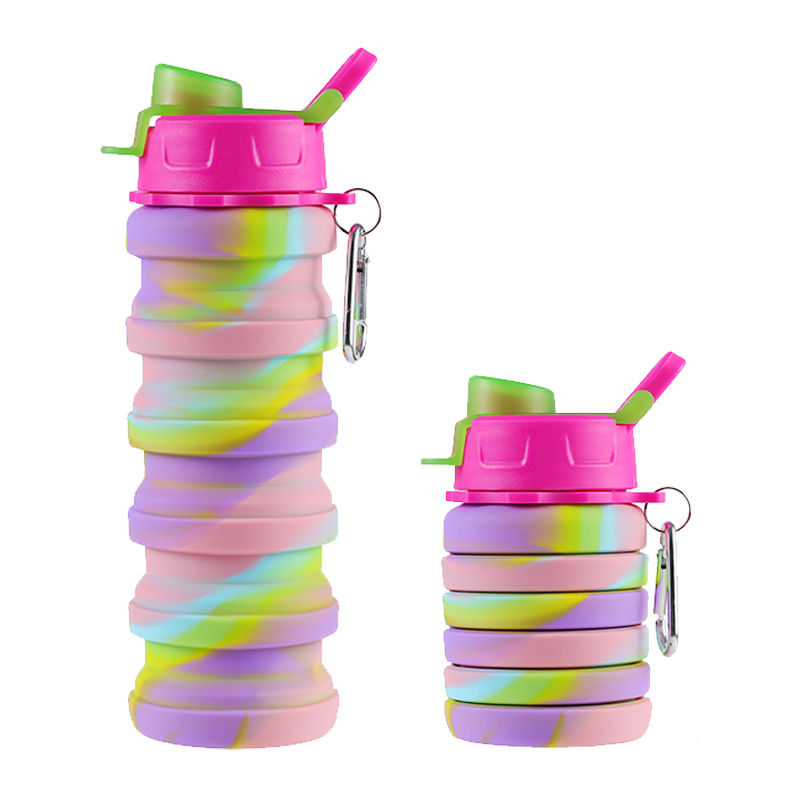
When a product needs to fold flat and then go through a dishwasher cycle on a regular basis, material choice moves from a preference to a survival test. Rigid plastics like standard acrylic or thin polycarbonate may look fine initially, but they develop micro-cracks at the folding hinge after a few dozen bends. Food-grade silicone, on the other hand, is genuinely elastic enough to take thousands of folds without showing stress whitening or tearing. It also shrugs off the heat and moisture of a dishwasher better than most thermoplastics.
Dishwasher durability is not just about surviving hot water. The combination of alkaline detergents, rinse aids, and sustained temperatures around 70–85°C breaks down many polymers through hydrolysis and thermal aging. Polypropylene and certain TPU blends handle this environment reasonably well, but they need to be formulated for repeated flexing. A generic PP container may survive the dishwasher, yet the same material in a thin living hinge will crack because the flexural fatigue limit is lower than the thermal requirement. Look for grades that explicitly mention both high flex fatigue resistance and dishwasher safety.
Testing data matters more than a material data sheet. Before committing, run a prototype through at least 300–500 fold cycles and 100 dishwasher cycles, then inspect the hinge area under magnification. If you see even faint whitening or surface crazing, that material will eventually fail in real use. The best combinations tend to be platinum-cured silicone for high-end products or a well-chosen polypropylene copolymer for budget-sensitive designs, but neither will work if the section thickness at the fold is too thin or too thick. Balance the geometry and the material as a single system.
Customization Levers That Boost Perceived Value
Perceived value rarely hinges on what a product costs to make. It leans heavily on whether the buyer feels the item was shaped around their needs. A well-chosen set of customization levers—say, choosing the length, the seam finish, or a subtle monogram placement—can shift a generic purchase into something that feels commissioned. When people see that a company has built flexible options into the mix without turning every choice into a chore, they're more willing to accept a higher price because the result no longer feels off-the-shelf.
Some of the most effective levers are small but visible. Swapping standard hardware for brushed brass, selecting a narrower strap, or adding a two-letter engraving doesn't add much complexity, yet it signals that the maker respects individual taste. The trick is keeping the menu tight: three to five meaningful options beat an open-ended configurator. Too many choices dilute the sense of curation and can make a premium product feel mass-produced in reverse. A short list of tasteful adjustments—color, material, size, personal mark—keeps the experience feeling exclusive without demanding hours of decision fatigue.
There's also a subtle psychological lift. When buyers invest even a little effort in tailoring, they start to see the object as partly their own creation. That co-ownership makes them defend the purchase, forgive minor flaws, and talk about it differently. Framing the standard version as a clean canvas rather than a stripped-down base also matters. Instead of saying "add leather for $40," present the leather option as a deliberate upgrade that complements the design. The perceived value grows not because the item is objectively better, but because the act of choosing made it impossible to compare directly with anything else on the shelf.
ODM Pricing Structures Brands Often Misread
Brands frequently assume ODM pricing follows a straightforward cost-plus model, but the reality is far more layered. Most ODMs bundle engineering, tooling, and component sourcing into a single quote, which can obscure where margins truly sit. A low unit price might signal efficient production—or it could hide royalty fees, minimum order penalties, and revision charges that surface only after the first production run.
Another common misread involves volume-based tiers. Brands see a sliding scale and presume each step reflects incremental material savings. In practice, ODMs often front-load amortization of molds and NRE costs into the earliest tiers, meaning the per-unit drop between 1k and 5k units might be modest while the 10k tier suddenly becomes much more aggressive. Missing this nuance leads to overcommitting on inventory or underestimating cash flow needs.
What trips up many buyers is the treatment of component substitutions. An ODM may quote with branded chips or connectors, then switch to generic equivalents mid-contract if the brand doesn't lock specifications into the pricing agreement. The initial price looks competitive, but the delivered BOM drifts—and with it, product performance or longevity. Savvy brands negotiate a frozen BOM clause and separate tooling ownership from per-unit pricing to avoid these silent cost shifts.
Passing Retail Compliance in North America and Europe
Retail compliance on both sides of the Atlantic demands more than a checklist—it requires reading between the lines of regional expectations. In North America, big-box retailers often enforce stringent vendor manuals covering everything from barcode placement to carton drop tests, while European chains lean heavily on sustainability documentation and chemical traceability under REACH. Missing a single deadline for updated spec sheets can trigger chargebacks that quietly erode margins, so successful suppliers build internal workflows that treat compliance not as a one-time audit but as a living protocol.
What trips many sellers is assuming one standard fits all. A packaging format approved by a Chicago-based distributor might fail a Parisian retailer’s requirement for recycled-content verification or multilingual labeling. Forward-thinking teams map each retailer’s compliance matrix side by side, flagging overlaps and gaps early in the product development cycle. They also schedule quarterly reviews with logistics partners, since a carrier’s routing guide in Germany may differ sharply from a Canadian cross-dock’s pallet height rules.
Ultimately, passing retail compliance in these two regions is about building redundancy into your quality systems. When a compliance update lands—say, a new plastic tax in Spain or stricter flammability standards in California—you want a dedicated owner who can cascade changes to factories, packaging designers, and freight forwarders within days, not months. That agility, more than any certificate on file, is what keeps your product on the shelf and your chargeback ledger clean.
Flat-Pack Logistics and In-Store Display Tactics
Moving a sofa through a narrow apartment door used to mean bruised knuckles and a lot of swearing. Flat-pack logistics changed that equation long before anyone thought about online checkout flows. By designing chairs, shelves, and wardrobes to break down into slim, rectangular boxes, retailers squeeze far more units into a single container and cut per-mile freight costs without passing the pain to the customer. The warehouse side gets quieter too: a pallet of unassembled nightstands takes up a fraction of the floor space, leaving room for faster restocking and less seasonal overflow.
On the sales floor, the challenge flips. A stack of identical brown boxes says nothing about how a room might feel, so display tactics lean hard into context. Walk through any big-box furniture hall and you will spot a fully assembled kitchen island next to a rack of flat boxes, positioned so the shopper can glance from finished product to package and back without losing the thread. Smaller retailers borrow the same trick with vignettes: a corner desk styled with a lamp and chair, plus a discreet stack of cartons tucked behind the display. That proximity lets customers gauge weight, read the box dimensions, and imagine the unboxing before they commit.
The most effective displays do not hide the flat-pack reality—they make it part of the story. Shelf talkers with hand-drawn assembly times, sample hardware mounted on a board, and open-box demos showing how the dowels fit together all lower the perceived risk of taking home an unbuilt piece. It is a quiet nudge, not a hard sell, and it works because the logistics already proved the product can travel cheaply. The store just has to prove it can arrive in a living room without turning into a weekend-long puzzle.
FAQ
A reliable partner should have in-house tooling, proven experience with food-grade silicone or TPU, and a clear process for iterative prototyping. Ask to see physical samples from previous collapsible bottle projects—not just standard bottles—because the folding structure creates unique weak points that only hands-on testing reveals.
Platinum-cured silicone remains the top choice for the body because it resists crease fatigue and doesn't retain odors. For rigid frames or caps, Tritan or polypropylene offer a good balance of impact resistance and weight. Avoid cheap thermoplastic elastomers that turn cloudy and sticky after repeated folding.
Move past the basic 'space saver' pitch. Think about real use cases: carabiner-ready caps for trail runners, a wide mouth that fits ice cubes, or a dual-wall base that lets the bottle stand upright when half full. Small ergonomic wins, like a textured grip zone that aligns with finger placement when collapsed, create a more memorable product than another bright colorway.
Buyers often focus on how the bottle looks on a shelf or hanging display. A matte-finish exterior reduces fingerprint smudges, while a debossed logo area avoids peeling printed graphics. Consider offering interchangeable cap colors or a clip system that lets users attach the bottle to different bag styles—retailers see that as add-on sales potential.
The most practical bottles compress to about one-third of their expanded height, but keep a rigid neck and firm mouthpiece. If a bottle flattens too aggressively, users struggle to hold it steady while drinking. Test prototypes with people who have smaller hands or reduced grip strength; that group quickly reveals whether your collapse mechanism demands too much force.
Beyond standard FDA or LFGB food-contact compliance, insist on repeated fold-cycle testing—at least 10,000 collapse-expand cycles—along with drop tests from 1.5 meters onto concrete. Leak testing should happen with the bottle filled to different levels, not just full, because partially filled collapsible bottles can create air pressure that forces water past the seal.
The hinge or fold lines are often too sharp, which creates stress whitening in rigid plastics or micro-tears in silicone. A good design uses graduated wall thickness and rounded internal corners at fold points. Also, many brands forget to include a small vent channel near the cap so the bottle doesn't vacuum-lock when collapsed and then refuse to expand.
Expect MOQs around 1,000 to 3,000 units per color, with lead times of 45 to 75 days after mold approval. Tooling costs for a custom collapsible design typically run higher than a standard bottle because the mold needs multiple moving parts for the folding sections. Budget for at least two pre-production sample rounds before final sign-off.
Conclusion
Many brands enter collapsible bottle ODM partnerships assuming they'll simply pick a mold and add a logo, yet the scope of what's actually included varies dramatically between suppliers. A dependable program covers everything from initial concept sketches and 3D prototyping to tooling, material testing, and assembly—not just the production run. Material selection is the unsung hero here: the best ODMs offer food-grade silicone or TPU blends engineered to withstand thousands of folds and high-heat dishwasher cycles without cracking or losing shape. Skipping these tests leads to returns and damaged reputations, so it pays to ask for independent lab reports before committing.
Beyond the basics, customization levers like custom caps, carry loops, measurement markings, or dual-material grips can sharply raise perceived value without massive tooling investments—yet many brands overlook them because they're busy misreading ODM pricing structures. Those quotes often hide costs for mold changes, minimum order quantities, or shipping duties that only surface later. Meanwhile, compliance isn't optional: passing FDA and LFGB food-contact standards is the baseline for North America and Europe, and missing a phthalate or BPA test can freeze an entire shipment. Finally, flat-pack design cuts warehouse and freight costs, and smart in-store display tactics—like hang tabs or compact countertop units—turn a space-saving product into an impulse buy. Brands that treat these ODM factors as connected pieces, not isolated boxes, will find the collapsible bottle category far more profitable than it first appears.
Contact Us
Contact Person: Cecilia
Email: [email protected]
Tel/WhatsApp: 8619057488653
Website: https://silwatbottle.com